
BLOG
Chemical Plant Gas Leaks:
Why Man-Down Detection Cuts Rescue Time
August 31, 2026
CATEGORY: ATEX ZONE SOLUTIONS
Three Men Went Down at 1 a.m. Nobody Knew for How Long
On 5 August 2026, sometime between 1 a.m. and 2 a.m., a chemical leak swept through a factory in the Kadechur-Badiala Industrial Area of Yadgir district, Karnataka. The workers on duty suffocated where they stood.
Three of them died. Vikram and Sanjay, both from Katni district in Madhya Pradesh. Ganesh, from Mahabubnagar in Telangana. All three were migrant labourers. All three were declared dead on arrival at hospital. Two more workers were carried out alive and moved to the Raichur Institute of Medical Sciences, one of them critical. Factory operations were suspended. Police opened an investigation. Days later, authorities still had not identified the chemical involved.
Read that timeline again. The leak happened in a one-hour window in the middle of the night. Five men were incapacitated. And the plant did not know.
That is the part every HSE Head in the fertiliser and chemical sector should sit with. Not the leak — leaks happen, and every process safety programme in the country is built around reducing their frequency. The part that killed these men is what happened *after* the leak. Nobody pressed an alarm, because nobody was conscious to press one. Nobody raised the alert, because the men who would have raised it were on the floor. On a thin night shift, in a plant with no automatic way to detect a worker down, the clock that matters is the clock between collapse and discovery. Ammonia, chlorine, hydrogen sulphide, nitrogen — the specific gas changes the pathology. It does not change that arithmetic.
Could this have been prevented?
Root Cause Analysis: The Failure Was Time-to-Discovery
Investigators will eventually name a valve, a flange, a reactor seal. That finding will be correct and it will be incomplete.
Every serious chemical release has two distinct failure chains. The first is the release chain — the mechanical or procedural fault that let the chemical escape containment. The second is the response chain — everything that determines how quickly an incapacitated worker is found and extracted. Indian process safety spends most of its budget on the first chain. The Yadgir fatalities were a second-chain failure.
While process safety focuses on containment, time-to-discovery determines survival. Key factors include:
Minimal Night Shifts: Longer patrol intervals eliminate mutual observation.
Passive Safety Blind Spots: Hypoxia renders workers unable to trigger manual alarms.
Rescuer Exposure: Blind entries without confirmed chemical locations turn single incidents into mass casualties.
Legal Liability: The Occupational Safety, Health and Working Conditions Code, 2020 (enforced 21 November 2025) imposes strict duties and penalties—up to 2 years imprisonment and ₹5 lakh fines—for safety contraventions leading to death
The Regulation Changed Under Your Feet — And Most Plants Haven't Noticed
The Occupational Safety, Health and Working Conditions (OSHWC) Code, 2020 came into force on 21 November 2025, repealing the Factories Act, 1948 and 12 other central laws. Continuing to cite Sections 7A, 41B, or 41C of the old Act leaves plants legally non-compliant.
Hazard-Free Workplace Duty: Imposes a positive, continuous obligation on employers that engineering designs (P&IDs) alone do not satisfy.
Lowered Safety Committee Threshold: Mandates Safety Committees for hazardous-process plants with $\ge$250 workers (down from 500).
Mandatory Reporting & Emergency Plans: Retains accident reporting and MSIHC Rules, 1989 obligations under the Environment (Protection) Act framework.
Personal Liability for HSE Personnel: Safety breaches causing death carry up to 2 years imprisonment, fines up to ₹5 lakh, or both (with $\ge$50% paid to victims’ heirs). Penalties attach to responsible individuals, not just corporate entities.
DownAlert: An Alarm That Does Not Need a Conscious Worker
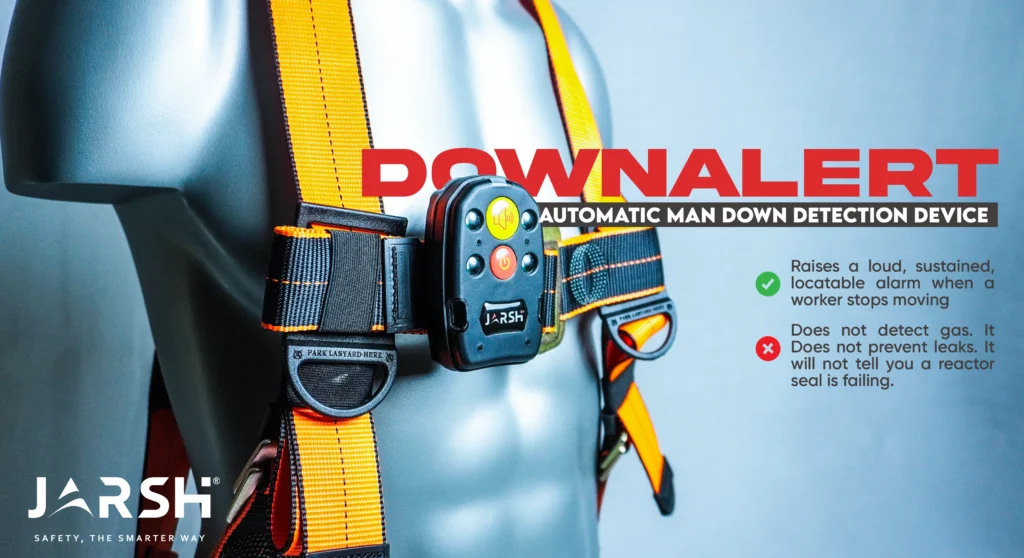
Let us be precise about what this product does, because precision matters more than marketing here.
DownAlert does not detect gas. It does not prevent leaks. It will not tell you a reactor seal is failing. Jarsh Safety makes no such claim.
What DownAlert does is close the response-chain gap. It is an automatic man-down detection device, ATEX certified for hazardous areas, that raises a loud, sustained, locatable alarm when a worker stops moving — with no action required from the worker at all.
The technical envelope, from the JDA-ATEX datasheet:
| Specification | Value |
|—|—|
-
| Device mass | 163.8 g |
-
| Enclosure | High-impact polycarbonate, flame retardant |
-
| No-motion detection threshold | 30.09 seconds of inactivity |
-
| Pre-alarm activation time | 15.18 seconds |
-
| Pre-alarm sound level | 101.7 dB |
-
| Main alarm sound level | 101.0 dB |
-
| Continuous alarm duration | 600+ minutes (10 hours) |
-
| Continuous operational uptime | 60+ hours |
-
| IP rating | IPx8 equivalent — functional after 1.5 m immersion for 2 hours |
-
| ATEX certification | Zones 1, 2, 20, 21, 22 |
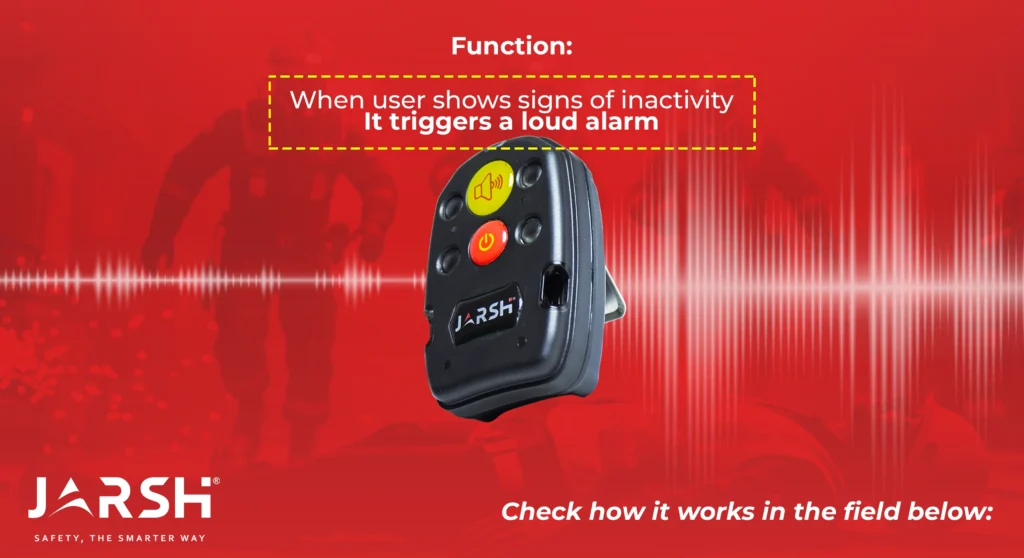
How Downalert Works in the Field
Deployment is simple enough to be adopted across a contract workforce, not just permanent staff.
-
Step 1: Issue Clip DownAlert to the worker's belt, harness strap, or coveralls at the start. At 163.8 g, it adds negligible load. No configuration by the worker.
-
Step 2: Wear through the hazardous area. ATEX certification across Zones 1, 2, 20, 21 and 22 means it stays on the worker throughout the reactor block, tank farm, bagging line and confined space entry — no removal at the zone boundary.
-
Step 3: Passive monitoring. The micro-motion sensing circuit tracks movement continuously. Normal work motion keeps it silent. No supervisor action, no dashboard to watch.
-
Step 4: Pre-alarm. After 30.09 seconds of no motion, a 101.7 dB pre-alarm fires for 15.18 seconds. A worker who is fine simply moves, and it clears.
-
Step 5: Main alarm. No response, and the main alarm sounds at 101.0 dB and sustains for up to 600 minutes, well beyond any realistic rescue window.
-
Step 6: Locate and extract. The orientation indication circuit guides the rescue team to the casualty. The time-recorded sound module time-stamps the distress signal, which supports both the extraction and the subsequent investigation.
For plants building the full hazardous-area stack: pair DownAlert with JAS Phone ATEX – an explosion-proof 5G smartphone rated IP68 and certified for Zones 1, 2, 20, 21 and 22, with an optional DMR variant for existing industrial radio networks – so the rescue team can coordinate from inside the zone. Add the JIB-AtEx-300 ATEX blower with PVC ducting to purge confined spaces before entry.
Talk to a Jarsh Safety Expert
If your plant runs night shifts in hazardous-process areas, ask one question: if a worker went down alone at 1 a.m. tonight, how long before anyone knew?
If the honest answer is measured in minutes rather than seconds, we should talk.
WhatsApp us on +91 8340 84 84 84 with the message: “Hi, I read your blog on man-down detection for chemical plants and want to understand DownAlert for our facility.”
We also conduct free facility safety assessments – an on-site walkthrough of your hazardous zones, night-shift manning, and emergency response chain, with a written gap report. No obligation.