
BLOG
Live Conductor, Dead Worker: Why Indian
Linemen Need Non-Contact Voltage Detection
JUNE 30, 2026
CATEGORY: ELECTRICAL SAFETY SOLUTIONS

A Worker Dead. An Enquiry. The Same Conclusions.
On 3 July 2025, a contract worker employed by M/S JBCO Powertech Pvt Ltd was fatally electrocuted in Kashipur Part II, Assam, while attempting to shift overhead electrical lines under the jurisdiction of APDCL – Assam Power Distribution Company Limited.
The formal enquiry that followed reached conclusions that would be familiar to any HSE head in the power sector. Work was conducted without proper authorisation. The empanelled contractor was absent from site. Safety protocols were, in the words of the official report, “grossly violated.” The worker made contact with a live conductor. He did not survive.
(Source: APDCL Enquiry Report, July 2025)
This incident did not happen in isolation. In Uttar Pradesh alone, data submitted to the Central Electricity Authority recorded 1,428 people killed in 1,316 electrocution cases in the single year of 2022–23 – an average of four deaths every day, the majority of them at substations, transformers, and poles carrying overhead high-tension lines. (Source: Directorate of Electrical Safety, UP / British Safety Council India, 2024)
The Central Electricity Authority’s own training data notes that nearly 70 to 80 percent of electrical accidents in India occur at voltages of 33kV and below — the working range of every distribution lineman in the country.
Could this have been prevented?
Why This Keeps Happening: The Root Cause
The Assam incident is not unusual. What the APDCL enquiry identified – unauthorised work, absent supervision, violated safety protocols – is the symptom of a deeper and more dangerous problem: electrical workers cannot see electricity.
A bare overhead conductor, whether dead or live, looks identical to the human eye. A substation bus bar that was de-energised an hour ago may have been re-energised by a control room operator, a fault protection relay, or a colleague at another end of the feeder – without the field worker knowing. In this environment, the standard assumption that “the line should be dead” becomes a fatal one.
The HSE vocabulary for this failure is precise: absent voltage verification at point of work. Even where Lockout/Tagout (LOTO) procedures exist, they address the isolation point – not necessarily the conductor the worker’s hand is approaching. Even where Permits to Work are issued, they cannot account for inadvertent re-energisation. Even where rubber gloves are provided, they fail if a worker reaches for a conductor he believes is dead and it is not.
The CEA Safety Regulations 2010, specifically under the provisions requiring protective equipment and safe working procedures for installations above 650V (Regulation 3 and associated schedules), mandate that no person shall work on or near a live conductor without appropriate precautions being taken. The precaution most consistently absent from India’s distribution workforce is a reliable, personal, real-time indicator of whether the conductor in front of them is live.
At 33kV and below – the voltage range where 70 to 80 percent of India’s electrical fatalities occur – a non-contact voltage detector worn on the body would alarm before the worker’s hand reaches the conductor. The worker would know. The accident would not have happened.
The technology exists. The gap is in deployment.
What the Regulation Actually Requires
The Central Electricity Authority (Measures Relating to Safety and Electric Supply) Regulations 2010, updated and reinforced in 2023, are the primary legal framework governing electrical safety for DISCOMs, Transcos, and contract workers operating on India’s power infrastructure.
Regulation 3 – General safety obligations: All persons engaged in electrical work must be equipped with appropriate protective equipment and must follow prescribed safety procedures before working on or near any conductor.
Regulation 29 – Alterations and repairs: No alteration or addition to an existing electrical installation may be undertaken except by a licensed electrical contractor with proper authorisation. Unauthorised work on live infrastructure – precisely what occurred in Assam – is a direct violation of this regulation.
Regulation 30 – Periodical inspection: Every installation above 650V must be inspected and tested at prescribed intervals. Safe-to-work verification at the point of work is implied within the broader inspection mandate.
The personal liability dimension matters here. Under the Electricity Act 2003 and the CEA Regulations, designated Electrical Safety Officers within DISCOMs and Transcos carry personal accountability for ensuring that safety measures are observed. When a contract fatality occurs under a DISCOM’s jurisdiction, the enquiry does not stop with the contractor. It reaches the principal employer.
The APDCL enquiry made this clear: the company was made to compensate the victim’s family, the incident was formally recorded, and the report explicitly called for “adherence to safety regulations in future operations.” The question is not whether your organisation needs voltage verification at point of work. The question is whether you have deployed it yet.
The Jarsh Solution: SmartVolt - Non Contact Voltage Detector

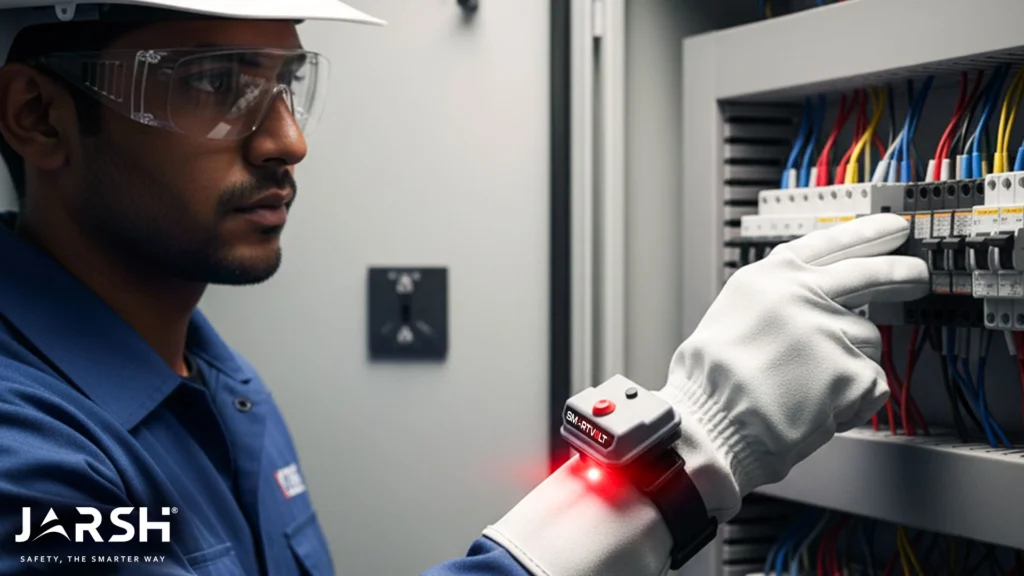
SmartVolt is the flagship safety product from Jarsh Safety – an indigenously designed and manufactured wearable non-contact voltage detector that detects the electromagnetic field of live conductors without any physical contact, and raises a visual and audio alarm before the worker reaches the danger zone.
It does what no written procedure, rubber glove, or LOTO tag can do: it gives the worker a real-time, personal signal about the electrical state of the conductor in front of them, at a safe distance, before any contact is possible.
How SmartVolt would have changed the Assam outcome:
The Kashipur worker approached overhead lines that were not confirmed dead at the point of work. A SmartVolt unit mounted on his helmet – weighing 70 grams, worn via a standard clip – would have begun alarming as he entered the electromagnetic field of the energised conductor. At 33kV, SmartVolt detects live voltage from 2.2 metres away. At distribution voltages of 220V, detection begins at 15 centimetres. The alarm – a red LED flash and audible buzzer – is immediate, unambiguous, and requires no action from the worker to activate.
Verified detection range by voltage level:
| Voltage | Detection Distance |
These are not claimed ranges. SmartVolt is tested and certified by the National Test House (NTH), Kolkata and ERDA, Gujarat – the two primary independent certification bodies for electrical safety equipment in India.
The device is IP55 rated, operates from 10°C to 50°C, runs for 150 hours on standard AAA cells, and includes a three-level battery indicator so a worker never goes into the field unknowingly under-powered.
The SmartPause™ function allows a worker to temporarily silence the alarm when deliberately entering a known energised zone – and auto-reactivates when they exit. This prevents alarm fatigue without compromising protection.
The JSVR-01 variant – commercially known as VoltRadar – is deployed at JSW Energy for electrical safety monitoring in power sector operations, validating SmartVolt’s performance in live industrial environments.
-
| 220V AC | 0.15 metres |
-
| 1 kV AC | 1.1 metres |
-
| 6.6 kV AC | 1.7 metres |
-
| 11 kV AC | 1.9 metres |
-
| 33 kV AC | 2.2 metres |
-
| 66 kV AC | 2.5 metres |
How SmartVolt Works in the Field
Deployment is simple enough to be adopted across a contract workforce, not just permanent staff.
-
Step 1: Mount the device. SmartVolt clips onto the helmet (side or peak mount), wrist band, or directly onto PPE. No tools required. Setup takes under 30 seconds
-
Step 2: Power on. A single button starts the device. The three-LED battery indicator confirms operational status. Runtime is 150 hours.
-
Step 3 — Approach the work area. As the worker moves toward a conductor, SmartVolt continuously samples the electromagnetic environment. No action is required.
-
Step 4 — Alarm activates at safe distance. If a live conductor is within detection range, the red LED flashes and the buzzer activates. At 33kV, this happens 2.2 metres before the worker's body reaches the conductor. At 11kV, at 1.9 metres. At 220V, at 15 centimetres.
-
Step 5 — Worker stops and verifies. The alarm prompts the worker to halt, back away, and verify whether the line was correctly de-energised. No phone call needed. No radio to the control room. The device on their helmet told them.
-
Step 6 — SmartPause™ if entering a known live zone. For work that deliberately involves proximity to live conductors with proper authorisation and protective equipment, the SmartPause™ function can be activated. The alarm resumes automatically on exit.
Deployed in the Field: What Indian Power Companies Are Doing
Jarsh Safety’s electrical safety portfolio is not theoretical. The VoltRadar (JSVR-01) – the industrial variant of SmartVolt – is actively deployed at **JSW Energy** for electrical safety in power sector operations.
Tata Power uses Jarsh electrical safety solutions across their facilities, reflecting the product’s suitability for large-scale, safety-critical power sector environments where multiple contract crews work simultaneously across high-voltage infrastructure.
These deployments demonstrate what SmartVolt does in practice, not just in a test house: it integrates into existing DISCOM and power company workflows without requiring operational changes, infrastructure modifications, or specialised training programmes. A lineman picks it up, clips it on, and goes to work.
Talk to a Jarsh Safety Expert
If your linemen are working on distribution lines, substations, or transmission infrastructure without a point-of-work voltage detection device, the Assam incident is not a cautionary tale from another organisation. It is a near-miss from your own future.
SmartVolt is certified, field-proven, and available for deployment across your workforce today.
WhatsApp us now on +91 8340 84 84 84